Wildlife Sanctuaries of Pakistan: Reserves That Save Species
Pakistan's national parks get the headlines, but a quieter network of protected areas does much of the country's heavy conservation lifting. These are the wildlife sanctuaries: around 60 reserves recognized under Pakistani law, set aside as undisturbed breeding grounds where wild animals can raise their young beyond the reach of hunters, traffic and development. They protect markhor valleys, dolphin barrages, desert dunes, highland lakes and a coral-fringed island in the Arabian Sea.
This guide explains what a wildlife sanctuary is under Pakistani law, how sanctuaries differ from national parks and game reserves, lists the major sanctuaries with their locations and wildlife, and tours the most important ones, from the Indus dolphin reserves to Pakistan's first marine protected area.
What is a wildlife sanctuary?
Under the Punjab Wildlife (Protection, Preservation, Conservation and Management) Act 2007, a wildlife sanctuary is any area, owned by the government or over which the government has proprietary rights, that is set aside as an undisturbed breeding ground for the protection of wildlife. The legal language is deliberate: the sanctuary exists first for breeding, for giving animals a place to reproduce without disturbance.
Two rules follow from that purpose. Public access is restricted or prohibited except in accordance with the rules, which means most sanctuaries are not tourist destinations in the ordinary sense. And no exploitation of the forest is allowed inside a sanctuary except for reducing fire hazards, fighting epidemics or insect attacks, or responding to other natural calamities. In other words, the law treats sanctuaries as places where nature's business comes first and human use is the exception.
Sanctuaries make conservation practical. They give researchers and zoologists segregated areas where they can study wildlife without the noise of visitors. They let authorities monitor endangered animals closely, and in some cases take a few individuals of species on the verge of extinction into captive breeding for later release. They are, in the plainest terms, safe rooms for wildlife.
How many wildlife sanctuaries does Pakistan have?
Pakistan has around 60 wildlife sanctuaries recognized in the IUCN-recognized national list, spread across all four provinces, Gilgit-Baltistan, Azad Kashmir and the Islamabad Capital Territory. The roster ranges from tiny wetland reserves of a few hundred hectares to desert sanctuaries covering hundreds of thousands of hectares.
The list includes familiar names and obscure ones: Astore and Baltistan in the northern mountains, Bajwat in the Sialkot plains, the Chashma and Taunsa Barrage dolphin sanctuaries on the Indus, Cholistan and Nara Desert in the southern sands, Hub Dam on the Sindh-Balochistan border, Mahal Kohistan in the Kirthar foothills, Naltar and Kargah in Gilgit-Baltistan, the Rann of Kutch on the Indian border, and wetland reserves such as Haleji, Kinjhar, Drigh and Hadero lakes. New sanctuaries are notified from time to time, and some older entries on paper lists have been upgraded, merged or reclassified, so the working count shifts slightly year to year.
Wildlife sanctuary vs national park vs game reserve
The three main categories of protected area in Pakistan are often confused. The comparison below, drawn from the legal definitions, keeps them straight.
| Feature | Wildlife sanctuary | National park | Game reserve |
|---|---|---|---|
| Legal purpose | Undisturbed breeding ground for wildlife | Protect scenery and wildlife in a natural state | Area managed for game species, where regulated hunting may be permitted |
| Public access | Restricted or prohibited except by rules | Open for research, education and recreation | Controlled access |
| Use of resources | No forest exploitation except emergencies | Roads and rest houses permitted for public use | Managed habitat, hunting under license |
| Typical size | Varies; many are large (desert sanctuaries exceed 400,000 ha) | Varies; from under 1,000 ha to over 1.3 million ha | Usually smaller, species-focused |
| Examples | Nara Desert, Haleji Lake, Astore, Chashma Barrage | Deosai, Hingol, Kirthar, Lal Suhanra | Head Qadirabad, various provincial reserves |
The practical difference for a visitor is simple. National parks are the places to go and see wildlife. Sanctuaries are the places where wildlife is left alone, and most are either closed to casual tourism or open only with special permission. Game reserves sit in between, managed partly around sustainable hunting of designated species.
Major wildlife sanctuaries of Pakistan
The table below lists the major sanctuaries with location, approximate area, year of establishment and key species. Figures follow the most commonly cited sources; exact areas vary between publications.
| Sanctuary | Location | Area (approx.) | Established | Key species |
|---|---|---|---|---|
| Nara Desert | Mirpurkhas, Sindh | 630,000 ha | 1980 | Chinkara, desert cat, caracal, houbara bustard |
| Cholistan | Bahawalpur, Punjab | 467,500 ha | – | Hog deer, blue bull, blackbuck, chinkara, desert wolf |
| Astore | Astore valley, Gilgit-Baltistan | 41,472 ha | 1975 | Astor markhor, snow leopard, Himalayan brown bear |
| Baltistan | Baltistan, Gilgit-Baltistan | 41,500 ha | 1975 | Snow leopard, Himalayan ibex, markhor |
| Mahal Kohistan | Jamshoro, Sindh | 70,577 ha | 1972 | Sindh ibex, urial, chinkara |
| Naltar | Naltar valley, Gilgit-Baltistan | 27,206 ha | 1975 | Markhor, snow leopard, Himalayan ibex |
| Hub Dam | Sindh / Balochistan border | 27,219 ha | 1981 | Mugger crocodile, waterbirds, Sindh ibex |
| Manshi | Kaghan valley, KP | 2,321 ha | 1977 | Himalayan black bear, musk deer, monal |
| Bajwat | Sialkot, Punjab | 5,400 ha | – | Hog deer, wild boar, waterbirds |
| Chashma & Taunsa Barrage | Mianwali, Punjab | – | 1972 | Indus river dolphin |
| Kargah | Gilgit, Gilgit-Baltistan | – | – | Markhor, ibex, snow leopard |
| Rann of Kutch | Tharparkar, Sindh | – | – | Flamingos, pelicans, desert wildlife |
| Haleji Lake | Thatta, Sindh | 658 ha | 1977 | Migratory waterbirds, flamingos |
| Kinjhar Lake | Thatta, Sindh | – | – | Waterbirds, crocodiles |
| Drigh Lake | Larkana, Sindh | – | – | Migratory ducks, herons |
Spotlight: the Indus dolphin sanctuaries
The most unusual sanctuaries in Pakistan protect an animal most visitors will never see: the blind Indus river dolphin, or bhulan. The Chashma and Taunsa Barrage Dolphin Sanctuary in Mianwali district, Punjab, was established in 1972 specifically to protect dolphin habitat in the Indus between two barrages. A second dolphin reserve covers the Guddu Barrage area in Sindh. In June 2026, the network grew significantly when Pakistan created the Punjnad Indus River Dolphin Sanctuary, protecting nearly 200 kilometers of river in Punjab and linking with the existing Sindh protected area into a contiguous 400-kilometer stretch.
These sanctuaries exist because the dolphin's range has been shattered by barrages into isolated compartments. Between protected stretches, dolphins cannot cross the concrete walls that divide the river. The sanctuaries keep the remaining compartments wet, guarded and as connected as possible, while WWF-Pakistan and wildlife department teams rescue dolphins stranded in canals when water levels drop. For a species down to about 2,000 individuals, every protected kilometer of river counts.
Spotlight: desert sanctuaries
Pakistan's desert sanctuaries are vast, remote and among the least visited protected areas in the country, which is exactly why their wildlife survives.
The Nara Desert Wildlife Sanctuary in Sindh's Mirpurkhas district, at roughly 630,000 hectares, is one of the largest sanctuaries in Pakistan. Its dunes and thorn forest shelter chinkara gazelle, desert cat, caracal, red fox, grey mongoose and a reptile fauna that includes monitor lizards and saw-scaled vipers. In winter, the houbara bustard arrives from Central Asia, and its presence draws both birdwatchers and, unfortunately, poachers.
The Cholistan Wildlife Sanctuary in Punjab, at about 467,500 hectares, protects the Cholistan desert's distinctive fauna: hog deer (parha), blue bull (nilgai), blackbuck, chinkara, desert wolf, small Indian civet and the caracal. Like Nara, it hosts the wintering houbara bustard, and conservation groups work to curb illegal hunting of the bird.
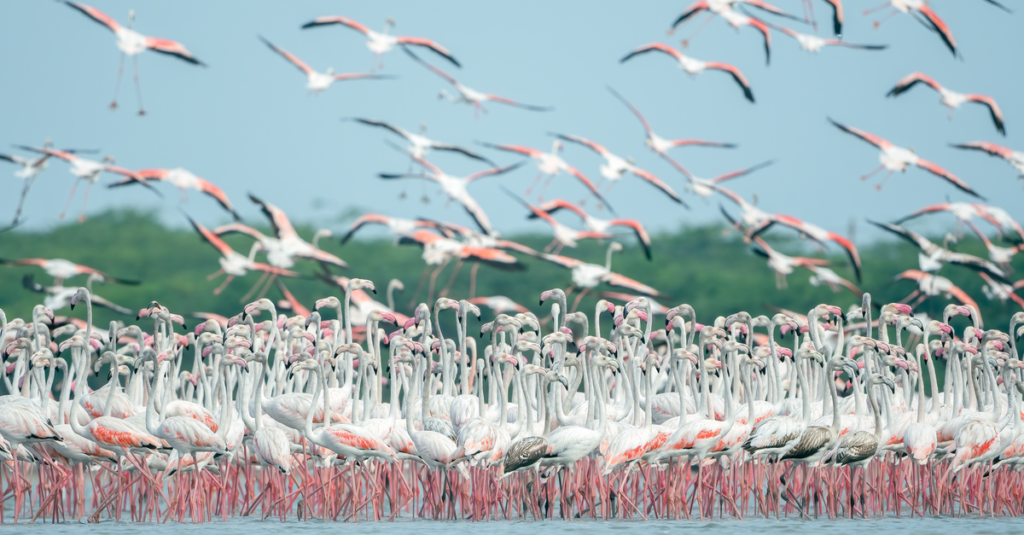
The Rann of Kutch Wildlife Sanctuary, on the border with India in Tharparkar, protects salt flats and thorn scrub that fill with flamingos, pelicans and other waterbirds after the rains. It is a landscape that looks empty until the water arrives, and then fills with wings.
Desert wildlife survives by blending rather than hiding, and much of it is nocturnal and shy. Visiting these sanctuaries demands patience, a good pair of binoculars and, in most cases, permission from the provincial wildlife department.
Spotlight: wetland sanctuaries
A remarkable share of Pakistan's sanctuaries are wetlands, and several are recognized internationally under the Ramsar Convention on wetlands of global importance.
Haleji Lake Wildlife Sanctuary in Thatta district, Sindh, at just 658 hectares, is small but disproportionately important. This freshwater lake, established as a sanctuary in 1977, hosts tens of thousands of migratory waterbirds each winter, including flamingos, pelicans, ducks and waders traveling the Indus flyway between Siberia and the Indian Ocean.
Kinjhar Lake (Kalri Lake), also in Thatta, is one of Pakistan's largest freshwater lakes and a major wintering ground for waterfowl, with mugger crocodiles in its reedbeds. Drigh Lake in Larkana district draws migratory ducks, herons and egrets. Hub Dam Wildlife Sanctuary, straddling the Sindh-Balochistan border and established in 1981, protects the reservoir and its surroundings: mugger crocodiles, resident and migratory waterbirds, and Sindh ibex in the surrounding hills.
These wetland sanctuaries are Pakistan's front line for migratory bird conservation. The Indus flyway funnels millions of birds through the country's lakes each year, and the sanctuaries give them somewhere to land.
Spotlight: mountain sanctuaries
In the north, sanctuaries guard the valleys where Pakistan's most famous mountain animals breed.
The Astore Wildlife Sanctuary in Gilgit-Baltistan, covering 41,472 hectares of the Astore valley's northern catchment, is one of the few places protecting the Astor markhor, the flare-horned subspecies that is Pakistan's national animal. Snow leopards, Himalayan brown bears and Eurasian lynx move through the same valleys. The Baltistan Wildlife Sanctuary (41,500 hectares, 1975) and Naltar Wildlife Sanctuary (27,206 hectares, 1975) protect similar high communities of markhor, ibex and snow leopard. The Kargah Wildlife Sanctuary near Gilgit guards markhor and ibex habitat close to the town.
The Manshi Wildlife Sanctuary in Kaghan valley, Khyber Pakhtunkhwa (2,321 hectares, 1977), sits on the eastern bank of the Kunhar river and shelters Himalayan black bear, Himalayan musk deer and pheasants including the monal. Reached by a rough track via Paras that closes in winter snow, it is the kind of sanctuary that rewards the determined.
Spotlight: Astola Island, Pakistan's first marine protected area
Pakistan's most unusual sanctuary is not on land at all. Astola Island, off the Balochistan coast near Gwadar, is the country's first marine protected area. The island and its surrounding waters protect nesting green and olive ridley turtles, coral reefs, dolphins and dense seabird colonies.
Astola matters because Pakistan's marine conservation has lagged far behind its terrestrial efforts. The island's designation as a protected area recognized that the country's biodiversity does not stop at the shoreline. The best time to visit is March to October, when seas are calmer, though access requires a boat from the mainland and permission from the authorities. For now it remains a frontier destination, which has kept its reefs and turtle beaches in remarkable condition.
Can you visit a wildlife sanctuary?
The honest answer is: sometimes, with permission, and often not at all. Unlike national parks, sanctuaries are legally closed to casual public access. Their purpose is undisturbed breeding, and managers take that seriously.
That said, some sanctuaries accommodate visitors. Wetland sanctuaries such as Haleji and Kinjhar lakes are accessible for birdwatching, particularly in the winter migratory season from November to February. Astola Island can be visited with proper arrangements. For most others, from Nara Desert to Astore, you will need to contact the relevant provincial wildlife department, explain your purpose, and obtain permission. Researchers, student groups and organized ecotours have the best chances.
If you do visit, the rules are stricter than in a national park. Stay on designated routes, keep noise down, never approach breeding animals, take all litter with you, and follow the ranger's instructions exactly. The animals here are not habituated to people, and that is the point.
Practical timing: for wetland sanctuaries, winter (November to February) brings the migratory birds. For desert sanctuaries, winter is also the season, with bearable temperatures and active wildlife. For mountain sanctuaries, the window is summer (June to September), when tracks are open and snow has cleared.
Why sanctuaries matter more than their fame suggests
Sanctuaries rarely make the cover of tourism brochures, but conservation runs on them. National parks protect scenery and welcome visitors; sanctuaries do the quiet work of keeping breeding populations intact. The Astor markhor's survival owes much to the Astore sanctuary. The Indus dolphin's remaining strongholds are sanctuary waters. The houbara bustard's wintering grounds, the flamingo lakes, the ibex hills of Mahal Kohistan: all sanctuary land.
They are also where conservation's hardest problems concentrate. Poaching pressure, weak staffing, grazing conflicts and the sheer remoteness of desert and mountain reserves mean that a sanctuary's legal status is only the beginning. The reserves that work best share traits with the successful national parks: engaged local communities, consistent ranger presence, and boundaries that are patrolled rather than merely drawn.
There is also a quieter argument for sanctuaries that rarely gets made. Because they are closed to casual tourism, they preserve something increasingly rare: wild animals behaving as if people do not exist. Researchers studying undisturbed behavior, from markhor rutting rituals to the night movements of desert cats, depend on these closed spaces. In an age when almost every landscape is photographed, the sanctuary's closed gate protects not just animals but the integrity of the science done around them.
FAQ
What is the difference between a wildlife sanctuary and a national park in Pakistan? A wildlife sanctuary is set aside by law as an undisturbed breeding ground for wildlife, with public access restricted or prohibited. A national park protects scenery and wildlife while remaining open to the public for recreation, education and research.
How many wildlife sanctuaries are there in Pakistan? Around 60 sanctuaries are recognized in the national list, across all provinces and territories. The exact number shifts as new areas are notified.
Which is the largest wildlife sanctuary in Pakistan? The Nara Desert Wildlife Sanctuary in Sindh, at roughly 630,000 hectares, is among the largest, followed by the Cholistan Wildlife Sanctuary in Punjab at about 467,500 hectares.
Can tourists visit wildlife sanctuaries in Pakistan? Most sanctuaries restrict public access by law. Some, such as Haleji and Kinjhar lakes for birdwatching and Astola Island, can be visited with proper arrangements and permission from the wildlife department.
Which sanctuary protects the Indus dolphin? The Chashma and Taunsa Barrage Dolphin Sanctuary in Punjab (1972) and the Guddu Barrage reserve in Sindh, joined in June 2026 by the new Punjnad Indus River Dolphin Sanctuary, which created a contiguous 400-kilometer protected stretch.
What is Pakistan's first marine protected area? Astola Island off the Balochistan coast, protecting nesting sea turtles, coral reefs, dolphins and seabird colonies.
Pakistan's wildlife sanctuaries will never be as famous as its national parks, and that is by design. They are the quiet rooms of the country's conservation estate: the breeding valleys, the wintering lakes, the guarded river stretches where the next generation of markhor, dolphins, bustards and flamingos gets its start. Knowing they exist, and why they are closed, is the first step toward valuing what they protect.