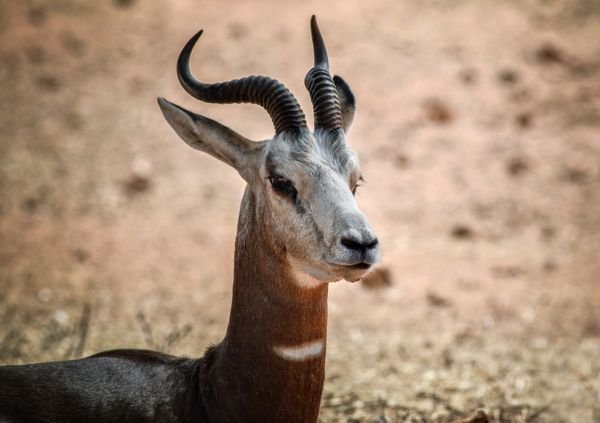
Chinkara Gazelle in Pakistan: The Desert Ghost of Thar
At first light in the Thar desert, a slender shape detaches itself from the thorn scrub and freezes. Reddish-buff coat, white belly, dark stripes running from each eye to the muzzle, horns rising in a neat S-curve. It watches for a few seconds, then vanishes between the bushes with a grace that makes the desert look easy. This is the chinkara, the Indian gazelle, one of Pakistan's most elegant desert animals and one of its most pressured.
The chinkara (Gazella bennettii) is a true gazelle, native to the arid belt stretching from Iran through Pakistan into India. In Pakistan it haunts the Thar and Cholistan deserts, the plains of Balochistan, the Salt Range of Punjab and the rocky slopes of Kirthar. Globally it is not yet endangered, but inside Pakistan its numbers have been severely reduced by hunting, and researchers admit they lack even baseline population estimates for the country. This guide covers how to identify a chinkara, where it lives in Pakistan, how it survives without water, and what threatens it.
What is the chinkara?
The chinkara, also called the Indian gazelle, is a small antelope of the genus Gazella, described scientifically as Gazella bennettii by Sykes in 1831. It is the only gazelle species found in the Indian subcontinent, out of 19 gazelle species across Asia and Africa.
Taxonomists recognize six subspecies, and three of them occur in Pakistan. The Gujarat chinkara (G. b. christii) ranges across the desert lowlands of Pakistan and western India, including the Thar and the Rann of Kutch region. The Kennion or Baluchistan gazelle (G. b. fuscifrons), the darkest subspecies, occurs from eastern Iran through Balochistan to Sindh. The Salt Range gazelle (G. b. salinarum) is found in Punjab's Salt Range and eastward toward Delhi. The other three subspecies, Deccan, Bushehr and jebeer, live in India and Iran.
On the IUCN Red List, the chinkara is assessed as Least Concern, and it is listed on CITES Appendix III. Those global labels can mislead, though. The assessment reflects large populations in India; in Pakistan and Iran the species has declined sharply and survives mainly in protected pockets. Pakistani researchers describe it plainly as a species under severe pressure within the country's borders.
How to identify a chinkara
The chinkara is built like a creature designed by wind: light, narrow and quick. Adults stand about 65 cm at the shoulder and weigh roughly 23 kg, with body length around 0.9 to 1.2 meters.
The coat is the first clue. In summer it is a reddish-buff color with smooth, glossy fur that blends into dry grass and sand. In winter the white of the belly and throat stands in greater contrast against the darker back. The face carries the gazelle signature: dark chestnut stripes running from the corner of each eye to the muzzle, bordered by white stripes, plus a dusky patch above the nose. These markings are visible at surprising distances and separate the chinkara instantly from deer.
The horns belong to the males. They rise almost straight when seen head-on, curving in a light S-shape in profile, ringed with 15 to 25 ridges, and average 25 to 30 cm, occasionally reaching over 39 cm. Males are larger and carry the heavy ringed horns; females are slighter, with thin horns or none at all. That difference between the sexes is pronounced enough that early naturalists sometimes treated lone females as a separate kind of animal.
In motion, the chinkara is unmistakable. It is shy and avoids human habitation, so most encounters are brief: a flick of white rump, a bounding run called pronking or stotting in which all four feet leave the ground together, and then stillness behind the next bush. Watch long enough and the bush itself seems to exhale, because the gazelle has already slipped away to the next patch of cover.
Chinkara vs similar desert antelopes
Pakistan's deserts hold several small antelopes and deer that visitors confuse with the chinkara. The table below sorts them out.
| Feature | Chinkara (Indian gazelle) | Blackbuck | Goitered gazelle |
|---|---|---|---|
| Scientific name | Gazella bennettii | Antilope cervicapra | Gazella subgutturosa |
| Size | ~65 cm, ~23 kg | ~75 cm, ~35 kg | ~70 cm, ~30 kg |
| Male horns | S-curved, ringed, 25-39 cm | Long spirals, up to 70 cm | S-curved, shorter |
| Face markings | Dark chestnut eye-to-muzzle stripes | White eye rings, no stripes | Pale face, throat swelling in males |
| Range in Pakistan | Thar, Cholistan, Balochistan, Salt Range, Kirthar | Cholistan, Lal Suhanra (reintroduced) | Rare; border areas with Iran/Afghanistan |
The blackbuck is the easiest to separate: adult males are strikingly black above and white below with corkscrew horns, and in Pakistan the species survives mainly through reintroduction at Lal Suhanra. The goitered gazelle is a close cousin with a thicker neck and paler face, but it barely enters Pakistan. If you see a small reddish gazelle with striped cheeks in the Thar or Cholistan, it is a chinkara.
Where chinkara live in Pakistan
The chinkara's Pakistani range is a map of the country's dry places. It lives in arid plains and hills, deserts, dry scrub and light forest, from sea level up to about 1,500 meters.
In Sindh, the strongholds are the Thar desert and the Kirthar range, including Kirthar National Park, where chinkara share the hills with Sindh ibex and urial. In Punjab, they occur in the Cholistan desert and the Salt Range, with a small reported population in the Margalla Hills near Islamabad and around Kala Bagh. Lal Suhanra National Park in Bahawalpur protects Cholistan-edge habitat where chinkara are a management priority alongside blackbuck and blue bull. In Balochistan, they range across the arid plains and valleys, with recent field studies focused on Khuzdar and Lasbela districts.
The table below summarizes the key Pakistani populations and their subspecies.
| Region | Subspecies | Key areas |
|---|---|---|
| Thar desert, Sindh | Gujarat chinkara (G. b. christii) | Tharparkar, Rann of Kutch edge |
| Cholistan, Punjab | Gujarat chinkara (G. b. christii) | Cholistan desert, Lal Suhanra NP |
| Balochistan plains | Baluchistan gazelle (G. b. fuscifrons) | Khuzdar, Lasbela, Dera Bugti |
| Salt Range, Punjab | Salt Range gazelle (G. b. salinarum) | Salt Range hills, Kala Bagh |
| Kirthar range, Sindh | Baluchistan gazelle (G. b. fuscifrons) | Kirthar National Park |
Protected areas matter enormously for this species. In Iran it is now largely confined to protected areas, and the same pattern is emerging in Pakistan, where the safest herds live inside national parks and wildlife sanctuaries such as Kirthar, Lal Suhanra, Hingol and the Cholistan and Nara desert sanctuaries.
Life without water: desert survival
The chinkara's most remarkable trait is its independence from drinking water. It can go without water for long periods, drawing sufficient fluids from the plants it eats and from dew. This is not a minor convenience in the Thar, where summer temperatures cross 45 degrees Celsius and surface water vanishes for months. It is the difference between living in the desert and merely visiting it.
Several adaptations work together. The chinkara feeds mainly at dawn and dusk and is partly nocturnal, avoiding the worst heat. Its light coat reflects sunlight, and it can let its body temperature fluctuate to save water that would otherwise go to cooling. Its kidneys concentrate urine efficiently, and it selects moisture-rich browse, shifting between grasses, herbs and the leaves, twigs, flowers and fruits of desert shrubs as the seasons change.
Behavior helps too. Chinkara are usually seen alone or in small groups of up to four, which spreads grazing pressure thinly across sparse forage. During droughts they range more widely, following the patchy green-up after rare rains. Researchers in Balochistan note that the species occupies dry steppes, semi-arid deserts and arid valleys, adjusting its movements to where food and a little shade remain.
Diet, social life and breeding
The chinkara is primarily a browser, feeding on the twigs, leaves, flowers and fruits of small trees and bushes, supplemented with grasses and herbs. In the Thar it favors the new growth of desert shrubs; in the Salt Range it works the scrubby hillsides. This flexible diet is part of what lets it persist across such different arid landscapes.
Socially, the species is organized around territorial males. A dominant male defends a territory and gathers a small harem of females, and male-to-male competition intensifies during the breeding season. Males are more aggressive at this time, while females become more receptive. Courtship follows the classic gazelle pattern, with the male testing the female's condition before mating.
Breeding biology is well documented from both wild and captive studies. Males compete for access to females, and mating happens once a year in a defined season. Gestation lasts five to five and a half months, and twins are frequently reported. Most births occur in April, timed so that newborns arrive when spring forage is at its best. Females can conceive as yearlings, and calves may stay with their mothers for up to a year. This fast reproductive turnover helps populations recover when hunting pressure eases, which is one reason protection can work relatively quickly for this species.
Population: global comfort, Pakistani worry
Globally, the chinkara looks secure on paper. The IUCN estimated 50,000 to 70,000 mature individuals worldwide in its 2018 assessment, with India holding the great majority, including over 100,000 animals by some national counts. That abundance drives the Least Concern listing.
Pakistan is a different story. Researchers state bluntly that numbers in Pakistan have been severely reduced by hunting, and that the country lacks baseline data and reliable population estimates. Without knowing how many chinkara Pakistan holds, managers cannot say whether the population is stable, falling or recovering. The four-year study in Khuzdar and Lasbela, published in 2024, was among the first sustained field efforts in Balochistan, tracking fluctuations in chinkara numbers and gender ratios across seasons. Its authors flagged illegal hunting, urbanization and climate change as the key threats.
There are glimmers of encouragement. In 2026, wildlife watchers in Dera Bugti, Balochistan, reported a herd of about 15 chinkara moving together in the Tali Matt area, an unusually large group for a species usually seen alone or in fours. Local wildlife staff took it as a sign that the surrounding landscape might support hundreds more animals than previously assumed, and that habitat conditions in parts of Dera Bugti are improving. Single observations do not make a trend, but in a data-poor country, they matter.
Threats: poaching, habitat loss, weak enforcement
The chinkara is a protected species in Pakistan, yet protection on paper and protection on the ground are different things.
Illegal hunting is the oldest and most direct threat. Chinkara are hunted for meat, for sport and for prestige, and poaching incidents continue to spark public anger, including a widely shared 2025 case of a chinkara killing that drew condemnation online. Because the animals are shy and live in open country, they are easy targets for anyone with a vehicle and a rifle.
Habitat loss is the quieter threat. Expanding agriculture, settlements and roads fragment the arid plains the species needs. In the Thar, the spread of irrigated farming and infrastructure eats into desert habitat. In Balochistan, overgrazing by livestock competes directly with chinkara for the same sparse browse, and cutting of shrubs for fuelwood removes both food and cover.
Enforcement remains the weak link. Pakistan has declared protected areas, passed wildlife laws, imposed fines and made arrests, yet in remote deserts the wildlife department is thinly staffed and outgunned. Conservationists argue that without community buy-in, laws alone will not save the chinkara. The species' fast breeding rate means it can rebound if hunting is controlled, but only if the will and the rangers exist to control it.
Chinkara in the ecosystem
It is easy to treat the chinkara as decoration, but it plays a working role in desert ecology. As a browser and grazer, it shapes the structure of desert scrub, pruning shrubs and dispersing seeds in its droppings. It is prey for the desert's remaining predators: the Indian wolf, the striped hyena, the caracal and, where they persist, leopards. Its presence or absence is therefore a signal of the whole food web's condition.
Some researchers have even linked the chinkara's decline to one of the subcontinent's great extinctions. The Asiatic cheetah, which vanished from India in the mid-20th century, depended heavily on chinkara and blackbuck as prey, and the collapse of its food base is counted among the reasons the cheetah could not hold on. Within Pakistan, the chinkara's habit of feeding at dawn and dusk also makes it an important prey pulse for nocturnal predators, tying the small hours of the desert together. Protecting the chinkara today is partly about not repeating that history with the predators that remain.
FAQ
Is the chinkara a deer? No. The chinkara is a gazelle, a type of small antelope. Unlike deer, both sexes can carry permanent horns (males always do), and chinkara never grow antlers. The dark stripes on its face are the quickest way to tell it apart from deer.
Where can I see chinkara in Pakistan? Kirthar National Park and the Thar desert in Sindh, Lal Suhanra National Park and Cholistan in Punjab, and the plains of Balochistan around Khuzdar, Lasbela and Dera Bugti. Dawn and dusk in protected areas give the best chances.
How does the chinkara survive without drinking water? It gets moisture from the plants it eats and from dew, feeds at dawn, dusk and night to avoid heat, concentrates its urine, and ranges widely to find the greenest forage.
Is the chinkara endangered? Globally it is listed as Least Concern by the IUCN because of large Indian populations. In Pakistan, however, its numbers have been severely reduced by hunting and it is treated as a protected species under pressure.
What is the difference between a chinkara and a blackbuck? The chinkara is smaller and reddish-buff with striped cheeks and S-curved horns. The blackbuck is larger, with adult males black above and white below and long spiral horns. In Pakistan, blackbuck survive mainly through reintroduction at Lal Suhanra.
How fast can a chinkara run? Like most gazelles, the chinkara is built for speed and can outrun nearly everything in the desert over short distances, using a bounding gait in which all four feet leave the ground. Exact sprint figures for wild chinkara are not well documented, but gazelles of this size typically reach 60 to 80 kilometers per hour in bursts.
How many babies does a chinkara have? Usually one or two. Gestation lasts five to five and a half months, twins are common, and most births happen in April.
The chinkara asks for little: scrub to browse, space to run, and to be left alone. Pakistan's deserts can still provide all three. Whether the ghost of the Thar keeps haunting the dunes at dawn depends on the unglamorous work of stopping poachers, protecting rangeland, and finally counting how many of these gazelles the country has left.