Coral Bleaching Causes: Why Reefs Are Turning White
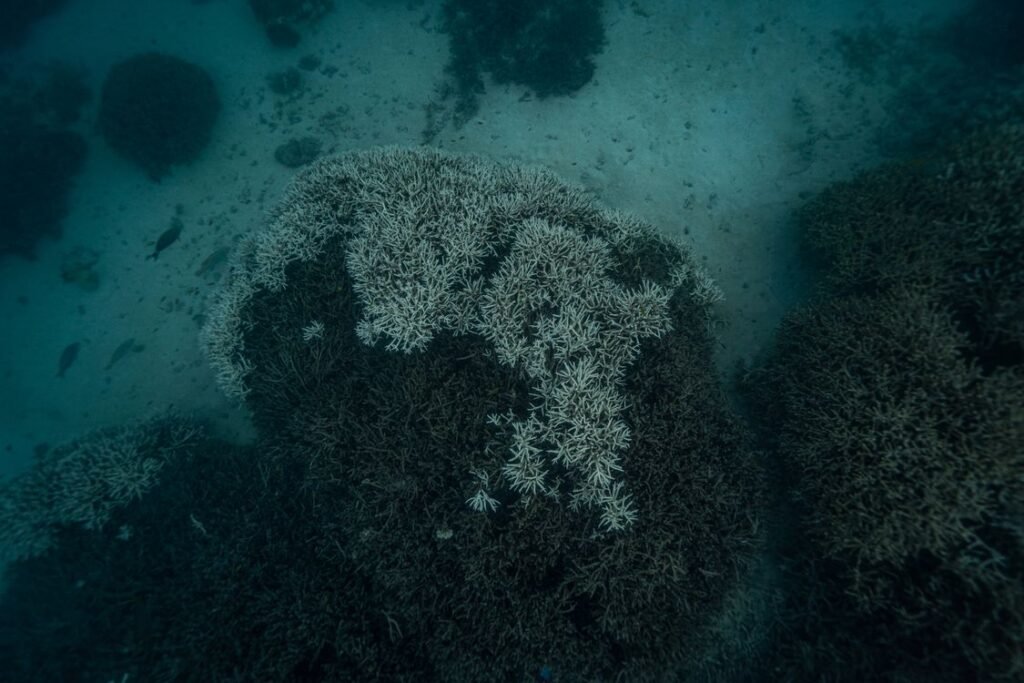
From the air, a bleached reef looks like a snowfield dropped into the tropics. Where there should be gardens of branching staghorn in gold and violet, there are only white skeletons gleaming through transparent tissue. It is one of the most haunting sights in nature, and it has become far too common. Coral bleaching, once a rare curiosity, is now a regular global emergency, striking reefs from Australia to the Caribbean to the Indian Ocean with growing frequency.
This guide explains what coral bleaching is, what causes it, how bad the latest global event has been, and whether reefs can come back. Along the way, we will meet the tiny algae at the heart of the story and the scientists racing to give reefs a fighting chance.
What coral bleaching actually is
Bleaching is a stress response, not a death sentence in itself. A coral animal lives in partnership with microscopic algae called zooxanthellae that dwell inside its tissues. The algae photosynthesize and share food with the coral, providing up to 90 percent of its energy according to NOAA, and they give the coral its color. The coral, in return, offers the algae shelter and carbon dioxide.
When stressed, this partnership breaks down. The coral expels the algae, and without their pigments the coral's tissue turns transparent, revealing the bright white calcium carbonate skeleton underneath. That is the "bleaching." The coral is still alive at this point, but it is starving and vulnerable. If conditions return to normal quickly, the algae can recolonize and color returns. If stress persists for days or weeks, the coral dies.
It helps to picture the margin involved. Corals live close to their thermal limits already. A rise of just 1 to 2°C above the normal summer maximum can trigger bleaching. In human terms, it is like developing a life-threatening fever from a change in room temperature that we would barely notice.
The zooxanthellae partnership
The coral-algae symbiosis is one of evolution's great bargains. Corals are animals, polyps related to jellyfish, and like all animals they need food. In the nutrient-poor waters of the tropics, catching plankton alone would not sustain a reef. The zooxanthellae solve this by acting as internal solar panels, converting sunlight into sugars that feed the coral directly.
This partnership is also why reefs grow where they do: in clear, shallow, sunlit tropical waters. And it is why the partnership is so fragile. The same sunlight dependence that powers the reef makes it sensitive to anything that disrupts photosynthesis, including excess heat and excess light.
When water warms beyond tolerance, the photosynthetic machinery inside the algae starts malfunctioning and producing harmful reactive oxygen compounds. The coral, sensing damage, ejects the algae. Scientists describe it as the coral choosing short-term survival over a toxic partnership, a gamble that only pays off if conditions improve soon. Recent research using advanced imaging has even visualized these structural changes inside living corals during bleaching, confirming that the breakdown begins at the level of the algae's light-harvesting membranes.
Cause 1: marine heatwaves
Rising ocean temperatures from climate change are the leading cause of mass bleaching, and by a wide margin. When sea surface temperatures spike above seasonal norms and stay there, entire reef systems bleach at once.
The numbers from recent events are stark. Between 2014 and 2017, heat stress affected about 70 percent of the world's coral reefs. The Great Barrier Reef has suffered seven mass bleaching events between 1998 and 2024, each driven by warming waters. Australia's reef authority calls bleaching the single biggest threat to the reef's future.
Then came the event now underway. The global bleaching event that began in 2023 is the worst ever recorded: heat stress has impacted 83.9 percent of the world's coral reefs. In the southern Great Barrier Reef in 2024, some fast-growing Acropora corals suffered mortality around 95 percent. Scientists estimate that 70 to 90 percent of coral reefs could be lost by 2045 if warming continues on its current path.
The mechanism is degree heating weeks, a measure of accumulated heat stress. Corals can often survive brief spikes, but prolonged exposure above their threshold overwhelms them. As baseline ocean temperatures rise, it takes a smaller anomaly to cross that line, which is why bleaching events are becoming more frequent, more severe, and more widespread.
Other causes of bleaching
Heat dominates the headlines, but several other stressors can bleach corals, sometimes alone and often in combination with warming.
Pollution and runoff. Storms can rapidly dilute coastal water, and runoff carries sediments, herbicides, oil, and excess nutrients like nitrate and phosphate. Sediment smothers corals and blocks light. Chemical pollutants, including oxybenzone from some sunscreens, stress the symbiosis directly.
Too much sunlight. High solar irradiance, especially ultraviolet, compounds heat stress in shallow corals. This is why bleaching often strikes hardest on sun-facing reef flats during calm, clear weather.
Extreme low tides. When tides expose shallow corals to air and sun, the combined desiccation and heating can bleach them within hours.
Cold stress. Unusually cold water can also trigger bleaching, as documented in events where cold snaps shocked subtropical reefs.
Disease and salinity shifts. Bacterial infections, sudden changes in salinity from floods, and destructive fishing practices like cyanide fishing add local stress that lowers the threshold for bleaching.
Ocean acidification. As the ocean absorbs CO2, the resulting chemistry shift weakens skeleton growth, making it harder for bleached corals to rebuild afterward.
| Cause | How it stresses corals | Scale |
|---|---|---|
| Marine heatwaves | Disrupts algal photosynthesis | Global, dominant driver |
| Pollution and runoff | Toxins, sediment, nutrient imbalance | Coastal, local |
| Excess sunlight | UV damage compounds heat | Shallow reefs |
| Extreme low tides | Air exposure, desiccation | Intertidal zones |
| Cold snaps | Thermal shock | Regional, rare |
| Disease | Weakens already stressed colonies | Local to regional |
| Ocean acidification | Slows skeleton regrowth | Global, chronic |
In practice, these causes interact. A reef weakened by runoff bleaches at lower temperatures. A reef hit by bleaching and then a storm may never recover. Conservationists call this the problem of compounding stressors, and it is why local protection matters even as the global thermostat rises.
The record 2023-2025 global bleaching event
The current global event deserves its own account because it has rewritten the record books. Beginning in 2023, a combination of a strong El Nino and underlying ocean warming pushed sea surface temperatures to unprecedented levels. In August 2023, the global average hit 20.98°C, then climbed to 21.06°C by February 2024, according to the Copernicus Climate Change Service.
The damage spread across every tropical ocean. In Australia, close to 40 percent of the Great Barrier Reef's individual reefs experienced very high or extreme bleaching, concentrated in the south. In India's Gulf of Mannar, early mass bleaching struck porite corals, half of which bleached, in a region that had already lost nearly half its coral cover, from 39 to 23 percent, in the mid-2010s event. Around Indonesia's Gili islands, surviving coral cover in some areas fell to about 10 percent of the reef area.
What alarms scientists most is the shrinking recovery window. Reefs need roughly a decade of calm water to rebuild, but major bleaching events are now arriving every few years in many regions. When the interval between events drops below the recovery time, reefs ratchet downward with each cycle.
How scientists monitor bleaching from space
You cannot station a diver on every reef, so scientists watch bleaching from orbit. NOAA's Coral Reef Watch program uses satellites to measure sea surface temperatures worldwide and computes heat stress in near real time. Its key metric, Degree Heating Weeks, accumulates temperature anomalies over a rolling 12-week window. When the value crosses thresholds, the program issues Bleaching Alert Levels, from watch to warning to Alert Level 2, signaling likely mass bleaching and mortality.
These alerts now reach reef managers days to weeks before the worst damage, letting them prepare response plans, prioritize monitoring, and sometimes take emergency measures like shading nursery corals. Complementary tools include the Allen Coral Atlas, which maps shallow reefs globally from satellite imagery, and a growing fleet of autonomous underwater vehicles and eDNA sampling that detect stress at the genetic level.
Citizen science adds ground truth. Programs like Reef Check train volunteer divers to survey standardized transects, feeding local observations into global databases. When a satellite flags a hotspot and divers confirm it, the picture sharpens. This blend of orbital surveillance and human eyes is how the 2023-2025 event was tracked reef by reef, in something close to real time.
Bleaching hotspots around the world
Bleaching is global, but its geography tells a story of vulnerability and, in places, resilience.
The Great Barrier Reef remains the most watched system. Seven mass bleachings since 1998 have progressively hit northern, central, and southern sections. Yet researchers have also found pockets of heat-tolerant corals and areas where recovery, when given time, is vigorous. The reef is not one story but thousands.
The Coral Triangle, spanning Indonesia, the Philippines, Malaysia, Papua New Guinea, Timor-Leste, and the Solomon Islands, holds the richest reefs on Earth and faces intense pressure. Indonesia's reefs have suffered repeated events, with some areas like the Gili islands reduced to fragments of former cover.
The Red Sea offers a scientific puzzle. Its northern corals live in naturally hot water and tolerate temperatures that bleach corals elsewhere, making the region a living laboratory for heat adaptation and a potential refuge, though even it has limits.
The Caribbean has lost the majority of its coral cover since the 1970s to the combined assault of bleaching, disease, hurricanes, and the die-off of key grazers like the long-spined sea urchin. Recovery there has been the slowest of any major reef region.
The Indian Ocean's reefs, from the Maldives to the Gulf of Mannar, sit in rapidly warming waters with dense coastal populations adding local stress. Their future depends heavily on both global emissions and local management.
Can bleached corals recover
Yes, sometimes, and the conditions matter enormously. If heat stress is brief and mild, corals can take up zooxanthellae again within weeks and regain color. Some corals even shuffle their algal partners, hosting more heat-tolerant strains after an event, a form of natural acclimatization.
But recovery of the full reef takes far longer. Even the fastest-growing corals need 10 to 15 years to fully recover their structure, according to a 2013 study in the journal Science. Slow-growing massive corals need decades. And recovery requires healthy conditions: clean water, intact fish populations that graze algae, and no repeat bleaching.
This is where the arithmetic turns grim. With global temperatures already about 1.3°C above pre-industrial levels and the ocean's surface layer warmed by 0.9°C on average, the calm decades reefs need are disappearing. Scientists are racing to help through coral gardening, assisted evolution of heat-tolerant corals, and larval reseeding, but all of these buy time rather than replacing the need to cool the planet.
What bleaching means for people
Coral reefs are not just beautiful. They are infrastructure. Reefs shelter roughly a quarter of marine species, support fisheries that feed hundreds of millions of people, protect coastlines by absorbing wave energy, and underpin tourism economies from the Red Sea to the Caribbean to Southeast Asia.
When reefs die, fish nurseries vanish, coastal erosion accelerates, and storm damage worsens. For low-lying island nations and delta coasts, reef loss compounds the threat of sea level rise. The economic value of reef services runs into the hundreds of billions of dollars globally, but the cultural loss, the disappearance of ecosystems that communities have depended on for millennia, cannot be priced. Protecting reefs is therefore not only an environmental cause but an economic and human one, tied directly to food security and coastal safety.
South Asia illustrates the stakes. The reefs of the Gulf of Mannar between India and Sri Lanka support fishing communities that have harvested these waters for generations, yet repeated bleaching has cut coral cover nearly in half. In the Maldives, where tourism built on reef beauty is the economic backbone, each bleaching event threatens livelihoods directly. Pakistan's own small coral communities along the Balochistan coast remain poorly studied, a reminder of how much reef science still needs local research. Across the region, the same pattern holds: the people least responsible for warming stand to lose the most from it.
Frequently asked questions
What causes coral bleaching? The main cause is marine heatwaves driven by climate change: water just 1 to 2°C above normal summer temperatures stresses the coral-algae partnership until the coral expels its algae. Pollution, excess sunlight, extreme low tides, cold snaps, disease, and ocean acidification can also cause or worsen bleaching.
Are bleached corals dead? Not necessarily. Bleached corals are alive but starving and vulnerable. If temperatures fall back to normal quickly, they can regain algae and color. If heat persists for weeks, they die.
Can a bleached reef recover? Individual corals can recover in weeks under good conditions, but full reef recovery takes 10 to 15 years for fast growers and much longer for massive corals. Repeated bleaching events now often arrive before recovery finishes.
Why is the 2023-2025 bleaching event the worst on record? It has affected 83.9 percent of the world's reefs, driven by record ocean heat combining a strong El Nino with long-term warming. Mortality in some regions, such as Acropora corals in the southern Great Barrier Reef, reached catastrophic levels.
What can be done to save coral reefs? The essential step is cutting greenhouse gas emissions to limit warming. Locally, reducing pollution and overfishing, protecting reefs in marine reserves, and supporting restoration science all improve the odds. Heat-tolerant coral breeding and reef restoration buy time, but they cannot substitute for cooling the planet.
Do all corals bleach equally? No. Branching corals like staghorns and Acropora tend to bleach first and die fastest, while massive boulder corals often resist longer. This selectivity is reshaping reefs, favoring slow-growing survivors over the fast-growing architects of reef complexity.
Is there any good news about bleaching? Some. Researchers are finding heat-tolerant coral populations, successful restoration projects, and reefs that rebound strongly when given clean water and time. These bright spots show what is possible if warming is limited.
A bleached reef is a warning written in white. It tells us, more vividly than any graph, that the ocean is running a fever. The causes are understood, the trajectory is clear, and the window for saving the world's reefs is still open, but it is narrowing with every fraction of a degree. What we do with that warning, in emissions cuts, in local protection, and in restoration science, will decide whether future generations inherit living reefs or only their skeletons. The science has done its job by diagnosing the causes with precision. The rest is up to us, and the clock is ticking in units of reef generations.