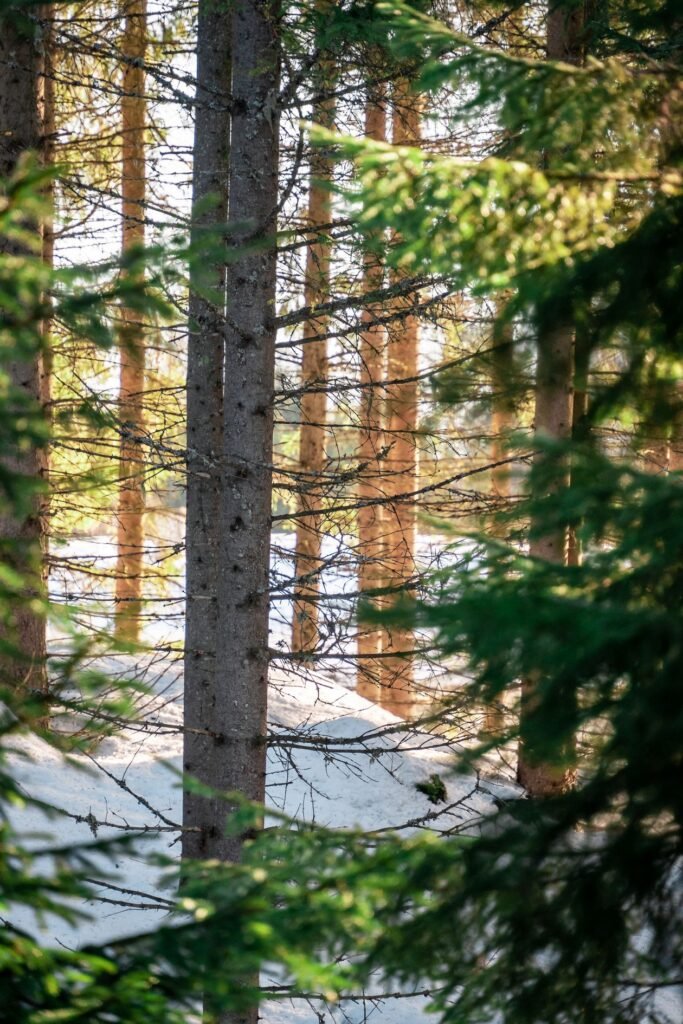
Boreal Forest Taiga Facts: Earth’s Greatest Wilderness
Imagine a forest so vast it rings the top of the planet like a green crown. It stretches from the Atlantic coast of Canada to the Pacific shores of Siberia, crossing an entire continent of Russia and wrapping around Alaska and Scandinavia along the way. In winter it endures months of darkness and cold that can freeze exposed skin in minutes. In summer it erupts into one of the greatest bird migrations on Earth. Beneath its trees lies a frozen vault of carbon larger than anything else on land.
This is the taiga, also called the boreal forest, and it is the world's largest land biome. Few people ever see most of it. Great stretches of the Siberian and Canadian taiga have no roads at all, and the forest simply runs on, river after river, ridge after ridge, farther than any traveler could walk in a lifetime. From the air, the view is almost abstract: dark green broken by the silver threads of rivers and the black mirrors of countless lakes, all of it exhaling oxygen and breathing in carbon on a scale no other forest can match.
Here are the facts that matter about this extraordinary wilderness, from its climate and creatures to its outsized role in the planet's climate future.
What Is the Boreal Forest (Taiga)?
The taiga is a biome defined by coniferous forest growing in the cold northern latitudes. The word "taiga" comes from Russian (related to Mongolic and Turkic languages), while "boreal" comes from Boreas, the Greek god of the North Wind. In North America it is usually called the boreal forest or snow forest; in Eurasia, especially Russia, "taiga" is the common term. Both names describe the same thing: endless forest dominated by pines, spruces, firs, and larches.
Its defining claim is scale. NASA describes the boreal forest as the world's largest terrestrial biome, and the European Space Agency notes that it covers about 15 percent of Earth's land surface. It forms a nearly unbroken circumpolar band across the Northern Hemisphere, sitting between the temperate forests to the south and the treeless tundra to the north. No other forest on Earth approaches its extent.
Where the Taiga Stretches Across the Earth
The boreal belt runs in a great ring around the top of the globe, mostly between 50°N and 70°N latitude. In North America it covers most of inland Canada and Alaska, plus parts of the northern contiguous United States (the Adirondack Mountains of New York mark the southernmost reach of the eastern transition zone). In Eurasia it covers most of Sweden and Finland, much of Norway, and Russia from Karelia in the west all the way to the Pacific Ocean, including the immensity of Siberia. It also reaches parts of Estonia, Iceland's lowland and coastal areas, northern Kazakhstan, northern Mongolia, and Hokkaido in northern Japan.
The distribution is lopsided: about half of the world's boreal forest lies in Siberia, roughly a third in Canada, and the rest in Alaska and Scandinavia. Russia alone holds the largest share of any country, and the composition of the forest shifts across that range. North America's taiga is mostly spruce. Scandinavia and Finland mix spruce, pine, and birch. Russia's varies by region, spruce and pine in the west, while the eastern Siberian taiga is a vast larch forest, one of the largest single forest formations on Earth.
A Climate of Extremes
The taiga's climate is classified as subarctic or boreal, and it is not subtle. Winters are long and severe, lasting six to nine months, with average temperatures that can plunge to minus 40 degrees Celsius. Summers are short and mild, with temperatures reaching around 20 degrees Celsius, and most precipitation falls during those warmer months, often as snow in the colder seasons. The growing season lasts only about 130 days, a brief window in which the forest must do nearly all of its growing.
Daylight swings wildly. In midsummer the sun barely sets across much of the taiga; in midwinter it barely rises. The snowpack itself becomes part of the climate system: deep snow insulates the ground, keeping the soil warmer than the air above it, which allows small mammals like voles and shrews to stay active all winter in tunnels beneath the snow. For the trees, that same snowpack is a slow-release reservoir, melting in spring to water the brief growing season.
Beneath the northern reaches lies permafrost, ground that stays frozen year-round, which limits how deep roots can go and shapes everything from drainage to the way the forest stores carbon. The soils are famously poor: thin, acidic, and nutrient-starved, leached by acids from fallen evergreen needles into a pale layer called podzol (or spodosol). Fallen leaves and moss can sit on the forest floor for years in the cold, decomposing with agonizing slowness.
Trees Engineered for the Cold
The taiga's trees are a short list of specialists, almost all conifers in the pine family. Spruces, firs, pines, and larches dominate, with only the occasional birch or poplar breaking the evergreen ranks. Their adaptations read like an engineering manual for winter.
The needle-like leaves are the key innovation. Slim and waxy, they lose far less water than broad leaves, which matters enormously when the ground is frozen and liquid water is unavailable for months. The conical shape of the trees lets heavy snow slide off rather than snapping branches. The dark green color of the needles absorbs maximum solar heat, helping photosynthesis restart quickly in the short spring. And being evergreen means the trees can photosynthesize whenever conditions allow, without spending precious weeks growing new leaves each year.
There is one famous exception: the larch. Larches are deciduous conifers, shedding their needles each autumn in a blaze of gold before the Siberian winter. Russian foresters even divide the taiga into "dark taiga" (forests dominated by spruce, fir, and dark-needled pines) and "light taiga" (larch and light-needled pine forests). Below the trees, a ground layer of mosses and lichens insulates the soil, helping to keep permafrost frozen and preserving the delicate forest floor. The root systems stay shallow by necessity, spreading sideways through the thin active layer of soil that thaws each summer above the permafrost, gripping a forest that can tower 20 metres tall with roots only a metre or two deep.
Much of the boreal's carbon sits not just in frozen mineral soil but in peatlands, the bogs and mires woven through the forest. In these waterlogged hollows, dead mosses and plant matter pile up faster than they can rot, building peat layer upon layer. Some boreal peatlands have been accumulating carbon for thousands of years, making them among the densest carbon stores per square metre on the planet, and among the most vulnerable when drainage or fire lets oxygen and heat in.
The Wildlife of the Taiga
For a biome with such harsh conditions, the taiga is surprisingly full of life, though its cast of characters is smaller than a tropical forest's. The big mammals are icons: moose, the largest deer on Earth, wading through muskeg and browsing on willow; lynx, ghostlike cats with snowshoe paws; grey wolves running in packs; brown bears fattening on summer abundance before winter sleep; reindeer and caribou migrating in great herds; wolverines, beavers, and snowshoe hares working the forest floor.
Summer transforms the forest. As the brief warmth arrives, insect populations explode, and millions of migratory birds pour in from the south to feast and breed: warblers, thrushes, flycatchers, owls, and eagles among them. The taiga becomes one of the planet's great nurseries, raising a generation of birds in a few frantic months before the cold returns and most of them leave again.
Survival strategies are stark. Many mammals grow extraordinarily thick winter coats. Bears hibernate. Birds and caribou migrate. The snowshoe hare and lynx grow wide, furred feet that spread their weight over deep snow. Everything about taiga wildlife is tuned to a single rhythm: endure the winter, exploit the summer.
| Animal | Claim to fame | Cold-weather strategy |
|---|---|---|
| Moose | Largest deer species; weighs up to 700 kg | Thick hollow-haired coat; long legs for deep snow |
| Canada lynx | Specialist hunter of snowshoe hares | Huge furred paws act as snowshoes |
| Grey wolf | Apex pack predator of the biome | Dense double coat; cooperative hunting |
| Brown bear | Gorges in summer, sleeps through winter | Hibernation; massive fat reserves |
| Reindeer / caribou | Long-distance migrator | Hollow insulating hairs; seasonal migration |
| Wolverine | Pound-for-pound powerhouse scavenger-predator | Extremely dense fur; frost-resistant |
| Great grey owl | One of the world's largest owls | Acute hearing to hunt voles under snow |
Earth's Largest Carbon Vault
Here is where the taiga goes from impressive to globally critical. The boreal forest is the largest terrestrial carbon reservoir on the planet, and most of that carbon is not in the trees at all. It is in the ground.
NASA research combining satellite data has put numbers on the vault: boreal vegetation and trees store around 38 petagrams of carbon, while the soils beneath store a staggering 1,672 petagrams. That soil figure represents about 50 percent of all the carbon held in soils worldwide. Altogether, the boreal biome accounts for roughly 20 percent of the total global forest carbon sink. National Geographic has reported that the boreal stores about 30 percent of the carbon found on the planet's surfaces, more than any other terrestrial ecosystem.
Why does so much carbon sit in the cold ground? The same slowness that defines the taiga: cold temperatures and waterlogged conditions mean dead plant matter decomposes at a crawl, so carbon accumulates in peatlands and frozen soils instead of returning to the air. The forest has been banking carbon this way for thousands of years. But that bank is vulnerable. The boreal has warmed about 1.4°C over the past century, and it is warming faster than any other forest type on Earth. As permafrost thaws and decomposition speeds up, carbon that took millennia to store can be released in decades.
A Surprisingly Young Forest
For all its primeval feel, the taiga in its current form is young. It has existed for only about 12,000 years, since the start of the Holocene epoch. Before that, much of its ground was buried under the Scandinavian and Laurentide ice sheets, or stretched out as mammoth steppe, the cold grassland where woolly mammoths roamed. As the ice retreated, conifers marched north behind it, colonizing the newly exposed land.
This youth explains some of the taiga's character: its relatively low tree diversity, its thin soils still recovering from glaciation, and the way its species are still, in geological terms, settling in. And the forest is still moving. A 2026 NASA analysis of four decades of Landsat satellite imagery found that boreal forests expanded by 0.844 million square kilometers (a 12 percent increase) between 1985 and 2020 and shifted northward by 0.29 degrees of mean latitude, with gains concentrated between 64°N and 68°N. The tree line is on the march, following the warming climate poleward.
Threats: Fire, Logging, and a Warming Climate
The taiga has always burned; fire is part of its natural cycle, clearing old stands so new ones can grow. But the fires are changing. In 2021, boreal forest fires contributed 23 percent of global carbon emissions, about 0.48 billion metric tonnes, the highest fraction since records began in 2000 and roughly double the carbon emissions of global aviation that year. Fires so intense they consume millions of acres and scorch the forest floor soil are becoming the kind of extreme disruptors that are remaking the boreal forest.
The deeper fear is a tipping point. Some scientists warn that the boreal could shift from a great carbon storehouse into a major source of greenhouse gas emissions this century, as warming thaws permafrost, lengthens fire seasons, and accelerates decomposition. Others argue the shift may already be underway in the most affected regions. Either way, the biome that has quietly absorbed humanity's carbon is now sending some of it back.
Logging is the other great pressure. The taiga is the world's largest source of timber, and industrial forestry, along with mining and infrastructure, fragments habitat and disturbs the carbon-rich soils. Sustainable management of this vast forest, balancing timber, indigenous livelihoods, biodiversity, and carbon, is one of the great conservation challenges of the century.
Taiga vs Tundra: Telling Them Apart
| Feature | Taiga (boreal forest) | Tundra |
|---|---|---|
| Defining vegetation | Dense coniferous forest | Treeless: mosses, lichens, dwarf shrubs |
| Location | 50°N-70°N, south of the tundra | Higher latitudes, north of the taiga |
| Winters | Long and severe, down to -40°C | Even colder, with continuous permafrost |
| Growing season | About 130 days | 50-60 days |
| Soils | Podzol/spodzol, acidic, nutrient-poor; patchy permafrost | Permafrost near surface, limiting root growth |
| Iconic animals | Moose, lynx, wolves, bears | Arctic fox, musk ox, polar bear, caribou herds |
Boreal Forest and Taiga: FAQ
Is the taiga the largest biome in the world?
Yes. The taiga, or boreal forest, is the world's largest terrestrial (land) biome. It covers about 15 percent of Earth's land surface in a near-continuous ring around the Northern Hemisphere, larger than any tropical rainforest, desert, or grassland biome.
What is the difference between taiga and boreal forest?
There is none in substance: "taiga" and "boreal forest" are two names for the same biome. "Taiga" comes from Russian and is more common in Eurasia, while "boreal forest" (from Boreas, the Greek god of the North Wind) is more common in North America. Both describe the cold-climate coniferous forest belt.
How cold does the taiga get?
Winter temperatures in the taiga routinely fall below -30°C and can reach -40°C, with winters lasting six to nine months. Summers are short and mild, around 15-20°C. The extreme cold, combined with frozen ground, is why only specialized conifers and cold-adapted animals thrive there.
What animals live in the boreal forest?
Iconic boreal animals include moose, Canada lynx, grey wolves, brown bears, wolverines, beavers, snowshoe hares, and reindeer/caribou. In summer, millions of migratory birds arrive to breed, feeding on the explosion of insects. Adaptations include thick fur, hibernation, migration, and snowshoe-like feet.
Is the boreal forest threatened by climate change?
Yes, seriously. The boreal is warming faster than any other forest type. Record wildfires (boreal fires produced 23 percent of global CO2 emissions in 2021), thawing permafrost, and accelerating decomposition threaten to turn the biome from a carbon sink into a carbon source. Satellite data also shows the forest shifting northward as the climate warms. Logging and mining add further pressure.
The boreal forest has been called the world's greatest wilderness, and it earns the title twice over: once for its staggering size, and again for the silent service it performs, holding half the planet's soil carbon in its frozen ground. It is a young forest doing an ancient job, and for the first time in its 12,000-year history, its future depends on decisions made far to its south, in the cities and capitals whose carbon it has been quietly absorbing all along.