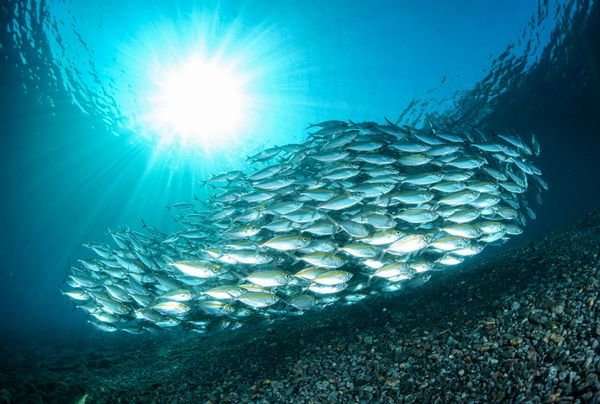
Sardine Run South Africa: The Greatest Shoal on Earth
Every southern-hemisphere winter, the sea off South Africa's east coast begins to glitter. Shoals of sardines millions strong pour northward along the shoreline, and behind them comes a hunting party of dolphins, sharks, diving seabirds, seals, and whales. The sardine run of South Africa is one of the largest animal migrations on the planet, a biomass movement that researchers say can rival East Africa's great wildebeest migration. It is also one of the least understood. Here is what science knows about the greatest shoal on Earth.
What is the sardine run?
The sardine run is an annual migration of the Southern African pilchard, Sardinops sagax, along the eastern seaboard of South Africa. Each year, countless sardines that spawn in the cool waters of the Agulhas Bank, off the southern Cape coast, move northward along the coast toward KwaZulu-Natal and on toward Mozambique. Their numbers are staggering: the run involves millions of individual fish traveling in shoals so vast they are visible from spotter planes and from the surface.
It is estimated to be the biggest migration on Earth in terms of sheer numbers of animals. The moving wall of silver draws predators from every direction, turning hundreds of kilometers of coastline into a rolling feeding frenzy. On the beaches, fishermen haul nets so full they sometimes sing traditional songs as they work, a scene that has played out on this coast for generations.
When does the sardine run happen?
The sardine run is a winter event. It typically begins in late May or early June and runs through July, sometimes extending into early August. Peak activity most commonly falls in June and early July, when the main shoals push up the Wild Coast and the KwaZulu-Natal south coast.
Timing shifts from year to year with ocean conditions. Scientists believe the water temperature must drop below about 21 degrees Celsius for the migration to get underway; without that tongue of cool water hugging the coast, the sardines simply do not come. Some years the run fails altogether. The sardines did not run in 2003, for the third time in 23 years, nor in 2006, and again there was no run in 2013 and 2014. For an event of this fame, its unreliability is part of the story: the ocean keeps its own calendar.
The route: from the Agulhas Bank to Mozambique
The journey begins on the Agulhas Bank, the broad, shallow continental shelf off South Africa's southern Cape coast, where sardines spawn. Their fertilized eggs drift on the open sea, carried by currents, and the hatched young eventually grow strong enough to swim back toward their spawning grounds.
Each winter, a fraction of the population takes a different road. A thin, seasonal strip of cool water forms along the east coast, squeezed between the shoreline and the warm, powerful Agulhas Current offshore. The sardines ride this inshore corridor northward: past the Eastern Cape's Wild Coast, up the KwaZulu-Natal south coast, and in strong years as far as Mozambique. It is a narrow highway, and its existence depends entirely on that cool water appearing. When the current pattern fails, the highway never opens, which is why whole seasons can pass with no run at all.
Why do sardines run? The science so far
For all its fame, the sardine run remains poorly understood ecologically, and researchers are refreshingly honest about that. The leading interpretation today is that the run is a seasonal reproductive migration undertaken by a genetically distinct population of sardines, not simply a feeding movement.
The oceanography gives the "how." The cold currents sliding along the Wild Coast are rich in plankton, the sardines' food, and the cool inshore strip lets a temperate-water fish push into subtropical latitudes it could not otherwise tolerate. The run is therefore a convergence of biology and physics: the right fish, the right temperature, and a current that opens like a door for a few winter months.
What scientists do not fully know is why only part of the sardine population runs, what triggers an individual shoal to join, or how climate-driven changes in currents and temperatures will reshape the event. The sardine run is a reminder that some of nature's greatest spectacles still keep their secrets.
The greatest shoal on Earth: the sheer scale
The numbers attached to the sardine run sound like exaggeration until you see the aerial photographs. Individual shoals are routinely described as more than 7 kilometers long, 1.5 kilometers wide, and 30 meters deep. A single shoal can hold millions of fish, and the run as a whole involves billions.
Sardines travel in these immense aggregations for a reason: safety. A lone sardine in open water is an easy meal; inside a shoal of millions, the odds for any one fish improve dramatically. The fish stay close to the surface and close to shore for much of the passage, and their movements are exquisitely coordinated. Sardines are supersensitive to motion, so a twitch at one edge of the shoal ripples through the whole mass in a wave of flashing silver. Predators have learned to exploit exactly this sensitivity, using it to panic and herd the fish into tighter and tighter balls.
Bait balls: how the hunt works
The bait ball is the sardine run's signature hunting formation, and dolphins are its chief architects. Pods of common dolphins work the shoals like sheepdogs, herding sardines toward the surface and blowing curtains of bubbles to pack them into dense, swirling spheres. Once a bait ball is formed, the dolphins take turns darting through it, plucking out individual fish.
Then the opportunists pile in. Sharks slash through the ball's edges. Cape gannets fold their wings and spear down from the sky like thrown javelins. Seals dart in for quick grabs. Even Bryde's whales lunge straight through shallow bait balls, engulfing tonnes of water and fish in a single mouthful. As the trapped sardines exhaust the oxygen in their shrinking pocket of water, they slow down, and the feeding grows frenzied. For divers, a working bait ball is the holy grail of the sardine run: a three-dimensional storm of silver, teeth, and feathers.
The predators of the sardine run
Dozens of species join the feast. These are the headliners.
| Predator | Scientific name | Role in the run |
|---|---|---|
| Common dolphin | Delphinus capensis | Primary herder; forms bait balls with bubble netting |
| Cape gannet | Morus capensis | Dive-bombs bait balls from the air; listed as Vulnerable |
| Cape fur seal | Arctocephalus pusillus pusillus | Opportunistic feeder, usually singly |
| Blacktip shark | Carcharhinus limbatus | Fast coastal shark that hits bait balls |
| Dusky shark | Carcharhinus obscurus | Large migratory shark feeding on the shoals |
| Bryde's whale | Balaenoptera brydei | The only baleen whale known to feed on sardine bait balls |
| Humpback whale | Megaptera novaeangliae | Present on its own migration; spectacular but coincidental |
The common dolphin deserves special mention: the arrival of dolphin pods along the KwaZulu-Natal south coast is the classic signal that the run has begun, and experienced dive operators shadow the dolphins, waiting for them to pin a shoal against the surface. The Cape gannet, meanwhile, brings its own conservation story. Confined to just six breeding islands and listed as Vulnerable, it depends on small fish like sardines, and overfishing of its prey is shrinking its world.
The Bryde's whale is the run's heavyweight specialist. Unlike the humpbacks, which are merely passing through on their migration from Antarctic feeding grounds to Mozambican breeding waters, Bryde's whales actively hunt the bait balls, lunging with mouths agape. For a diver in the water, a lunge-feeding whale materializing out of the blue is equal parts thrilling and humbling.
Meet the sardine: Sardinops sagax
The star of the show is a modest fish. The Southern African pilchard, Sardinops sagax, is a small, silvery, cylindrical member of the herring family, built for life in temperate coastal waters down to about 200 meters deep. Like many small pelagic fish, sardines perform a daily vertical migration, rising toward the surface at dusk and sinking at dawn.
The words "sardine" and "pilchard" are famously imprecise. They are common names applied to various small, oily herring-family fish, and what counts as a sardine changes by region: one British industry standard calls fish under 15 centimeters sardines and larger ones pilchards, while international canned-fish standards list more than 20 species that may legally be called sardines. Southern Africa's run, though, is one species, and its distribution stretches from southern Angola on the west coast all the way to north of Durban on the east. It appears off the east coast only during the run itself.
Sardines are classic forage fish: the middlemen of the marine food web, converting plankton into protein for everything above them. Humans use them too, for food, bait, fish meal, and oil. Globally, the Sardinops genus rides five great upwelling systems: the Kuroshio-Oyashio off Japan, the California Current, the Humboldt off Peru and Chile, the waters from the Bay of Cadiz to the North Sea, and the Benguela Current off southwestern Africa.
Watching the sardine run: best places and tips
For travelers, the sardine run is both a wildlife spectacle and a winter beach holiday. The prime window is June through early August, with June offering the peak. The legendary viewing grounds lie along the Wild Coast of the Eastern Cape: Coffee Bay, Port St Johns, and Mboyti are the names that come up again and again, with the KwaZulu-Natal south coast picking up the action as the shoals move north.
Seeing it well takes local knowledge. Dive operators along the coast run dedicated sardine run expeditions, launching boats each morning to find the dolphin pods and bait balls. Snorkeling and freediving put you in the middle of the action; scuba works too, though the real drama happens near the surface. Book with operators who follow responsible wildlife guidelines: no touching, no chasing, and respect for the animals' space.
If you cannot get to South Africa, the run has been filmed repeatedly for natural history documentaries, which remain the easiest way to witness a bait ball in full frenzy. Shore-based viewing can also be spectacular: on big days, the water boils with dolphins and diving gannets close enough to watch from the beach.
The sardine run by the numbers
A quick reference for the essential sardine run facts:
| Fact | Detail |
|---|---|
| Species | Southern African pilchard, Sardinops sagax |
| Season | Late May to early August; peak June to early July |
| Route | Agulhas Bank to the KwaZulu-Natal coast and Mozambique |
| Temperature trigger | Water below about 21 C |
| Typical shoal size | 7+ km long, 1.5 km wide, 30 m deep |
| Failed-run years | 2003, 2006, 2013, 2014 |
| Key predators | Common dolphin, Cape gannet, Cape fur seal, blacktip and dusky sharks, Bryde's and humpback whales |
| Claim to fame | Largest animal migration on Earth by number of individuals |
The human side: nets, livelihoods, and tourism
The sardine run is not only a wildlife event; it is a human one. When the shoals press close to shore, beach communities launch seine nets from the sand, hauling in flashing catches by hand. Observers have long noted the fishermen singing as they pull, turning hard labor into something closer to ceremony. For many coastal families, the run's arrival means weeks of work and food.
That tradition now shares the coastline with a newer economy: wildlife tourism. Dive operators from the Eastern Cape to southern KwaZulu-Natal run dedicated sardine run expeditions through the winter, and the event anchors a season of bookings for boats, guides, guesthouses, and restaurants. The same dolphins that herd bait balls have become the guides that lead tourists to them. Done responsibly, with distance respected and animals never chased, this economy gives the sardines a value beyond the net: alive and running, they are worth more to a coastal town than canned.
There is tension, of course. Nets and tourism want the same fish, and commercial purse-seine fisheries operating offshore want them too. Balancing these interests is the central management challenge of the run, and it is why scientists keep stressing the same point: the sardines are not just a catch or a spectacle, but the foundation everything else stands on.
Threats and conservation
The sardine run itself is a natural event, but sardines live in a fished ocean. Sardinops sagax supports commercial fisheries, and the same small pelagic fish targeted by nets are the foundation of the entire run ecosystem. Managing those fisheries sustainably matters far beyond the canning factory: every tonne of sardines removed is food denied to dolphins, gannets, seals, sharks, and whales.
Climate change adds uncertainty. The run depends on a precise alignment of cool water, currents, and temperature thresholds, exactly the kind of delicate oceanography that shifts as the planet warms. The failed runs of recent decades may be natural variability, or they may be early warnings. Long-term monitoring of the Agulhas Current system, including satellite mapping of the plankton blooms that feed the whole event, will be essential to telling the difference.
The hopeful note is that the run's fame is itself a form of protection. Ecotourism gives coastal communities a direct economic stake in healthy sardine stocks, and the spectacle draws global attention to the Wild Coast's marine riches every winter.
Sardine run: frequently asked questions
When is the sardine run in South Africa? Typically from late May or early June through July, sometimes into early August, with peak activity in June and early July. Timing varies yearly with water temperature and currents, and some years there is no run at all.
Where is the best place to see the sardine run? The Wild Coast of the Eastern Cape, especially around Coffee Bay, Port St Johns, and Mboyti, plus the KwaZulu-Natal south coast. Dive operators in these areas run dedicated expeditions during the season.
What is a bait ball? A bait ball is a dense, spherical aggregation of small fish formed when predators, especially dolphins, herd a shoal into a tight mass near the surface. Trapped and disoriented, the fish become easy targets for dolphins, sharks, seabirds, and whales.
Why do the sardines migrate? The leading scientific view is that the run is a seasonal reproductive migration by a genetically distinct sardine population, following a cool, plankton-rich inshore current northward. Much about it remains under study.
How big are the sardine shoals? Individual shoals are often described as more than 7 kilometers long, 1.5 kilometers wide, and 30 meters deep, containing millions of fish. The run as a whole involves billions of sardines.
A migration written in silver
The sardine run endures as one of nature's great set pieces because it compresses the whole ocean drama, migration, predation, cooperation, spectacle, into a few winter months on one coastline. Billions of small silver fish, following cold water north, feed a cast of predators that spans dolphins to whales, and remind everyone watching that in the sea, as on land, the greatest migrations belong to the humblest travelers.